
Why Ecommerce SEO Audits Fail in 2026
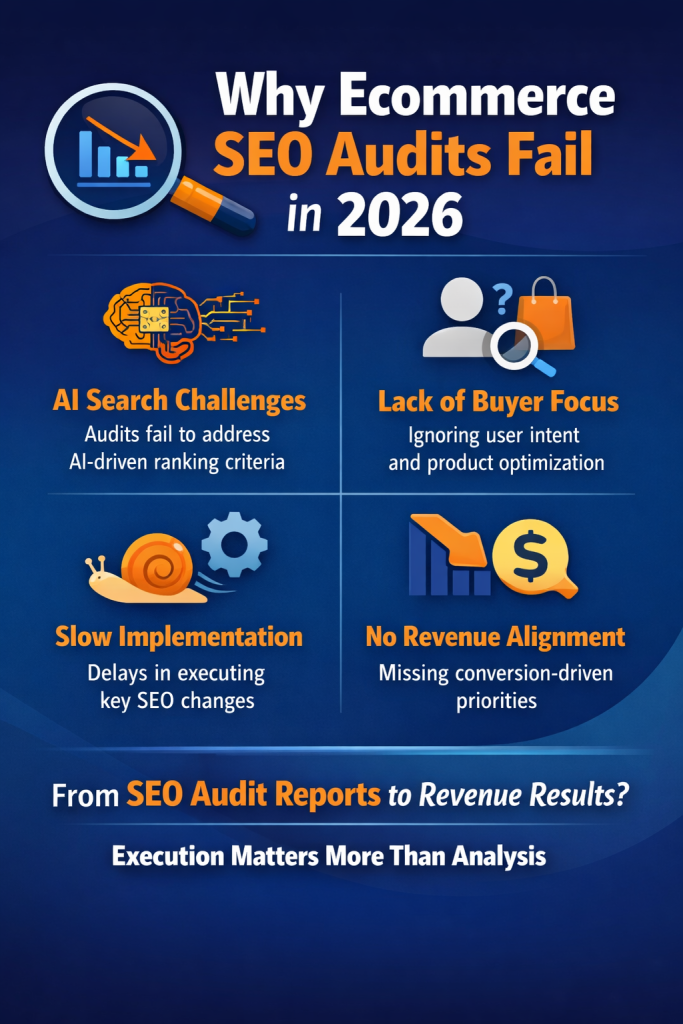
In 2026, search engines and AI-driven systems evaluate ecommerce websites based on clarity, intent, and user trust—not just technical compliance. SEO audits fail when they ignore product-level optimisation, internal linking logic, and conversion signals. Without fast implementation and revenue-focused priorities, audits remain documentation exercises rather than growth strategies.
Many businesses wonder why ecommerce SEO audits fail in 2026 even after investing in detailed reports. The reality is that most audits focus heavily on technical checklists instead of real buyer behaviour and revenue impact. This is also why SEO audits don’t improve ecommerce sales—recommendations often remain unimplemented, lack clear ownership, or ignore conversion-focused pages. Without prioritising high-intent product and category pages, SEO efforts lose momentum. Ecommerce SEO succeeds when audits evolve into execution-driven strategies that align search visibility with sales performance, not when they stop at documentation.
By Saurabh Banerjee
Universityofdigitalmarketing.org
Introduction: The SEO Audit Paradox in Ecommerce
Ecommerce businesses invest heavily in SEO audits with the expectation that rankings, traffic, and sales will improve. The irony is that most ecommerce SEO audits are technically correct — yet commercially ineffective.
The problem isn’t a lack of data. It’s a lack of execution, prioritisation, and revenue focus.
At Universityofdigitalmarketing.org, we’ve reviewed hundreds of ecommerce SEO audits across industries. A common pattern emerges: detailed reports, dozens of recommendations, and very little real-world impact. In this article, we’ll break down why ecommerce SEO audits fail, what businesses get wrong, and how a more practical, revenue-first approach can deliver results faster.
The Core Issue: Audits Focus on SEO, Not Business Outcomes
Traditional ecommerce SEO audits usually focus on:
- Technical errors
- Missing tags
- Page speed metrics
- Crawl issues
- Content gaps
While these elements matter, they rarely answer the most important business questions:
- Which pages are losing revenue?
- Where is buyer intent strongest?
- What changes will increase conversions this month?
SEO success in ecommerce is not about fixing everything — it’s about fixing the right things first.
Problem #1: Too Much Data, Too Little Direction
Most audits overwhelm stakeholders with:
- 50–100 pages of findings
- Long issue lists
- Generic best practices
The result? Decision paralysis.
When everything is marked as “important,” nothing actually gets done. Development teams push SEO tasks down the priority list, marketing teams lose momentum, and leadership sees SEO as slow or ineffective.
An effective audit should act like a business roadmap, not a technical encyclopedia.
Problem #2: The Audit + Retainer Trap
A common model in the industry is:
- Conduct a large SEO audit
- Sign a 6–12 month retainer
- “Gradually” implement fixes
This approach sounds logical but fails in practice for ecommerce brands because:
- Implementation gets delayed
- Focus shifts to reporting instead of results
- Revenue impact becomes unclear
Ecommerce moves fast. Waiting months to see results is unrealistic in a competitive market. SEO needs momentum, not maintenance.
Problem #3: SEO Recommendations Without Ownership
Another major reason audits fail is lack of accountability.
SEO recommendations often require:
- Developer time
- Content team support
- Product or category-level decisions
- Leadership approvals
Without a clear owner for each action item, recommendations remain theoretical. Successful ecommerce SEO requires cross-team coordination and a clearly defined execution plan.
Problem #4: Ignoring Buyer Intent and Conversion Signals
Many audits focus heavily on rankings and traffic but ignore how users actually buy.
For ecommerce, SEO success depends on:
- Clear product messaging
- Trust elements (returns, delivery, reviews)
- Strong internal linking
- Search intent alignment
If a product page ranks but doesn’t convert, SEO has failed its real purpose.
Problem #5: AI Search Has Changed the Game
Modern search engines and AI-driven discovery systems evaluate ecommerce sites differently than before. They don’t just scan keywords — they analyze:
- Product clarity
- Structured information
- Context and relevance
- Transactional signals
Audits that don’t account for how AI systems interpret ecommerce content risk becoming outdated before they’re implemented.
A Smarter Alternative: Revenue-Focused SEO Execution
Instead of massive audits, ecommerce brands need a focused, sprint-based approach that prioritises revenue impact.
At Universityofdigitalmarketing.org, we advocate for short execution cycles that:
- Identify high-impact opportunities
- Implement changes quickly
- Measure results immediately
This shifts SEO from a long-term promise to a measurable business function.
The 30-Day Ecommerce SEO Execution Framework
Week 1: Identify Revenue Leakage
Rather than auditing the entire site, focus on:
- Top revenue-driving categories
- High-traffic product pages
- Pages with impressions but low conversions
Key questions:
- Where is demand already present?
- Which pages are underperforming commercially?
- What small changes could unlock more sales?
This step aligns SEO directly with business metrics like conversion rate and average order value.
Week 2: Prepare High-Impact Improvements
Once priority pages are selected, improvements may include:
- Better product descriptions
- Clear value propositions
- Enhanced category content
- Improved internal linking
- FAQ sections addressing buyer objections
All changes are reviewed and approved quickly to avoid delays.
Week 3: Implement Changes
This is where most audits fail — and execution wins.
Implementation may involve:
- Content updates
- Structural improvements
- On-page optimisations
- Schema and internal navigation enhancements
The focus remains on pages that drive or influence revenue, not site-wide perfection.
Week 4: Validate and Measure Results
Instead of waiting months, early performance signals are tracked:
- Click-through rates
- Engagement metrics
- Conversion improvements
- Revenue per session
This creates confidence, clarity, and buy-in from stakeholders.
Types of High-Impact Ecommerce SEO Sprints
1. Product Page Optimisation Sprint
Improving:
- Descriptions
- Benefits
- FAQs
- Trust signals
- Structured data
Ideal for high-margin or best-selling products.
2. Category Page Optimisation Sprint
Enhancing:
- Introductory content
- Internal linking
- Filters and navigation
- Buyer guidance
Category pages often have the highest revenue potential in ecommerce SEO.
3. Messaging & Positioning Sprint
Clarifying:
- What the brand sells
- Who it’s for
- Why it’s better
This helps both search engines and users understand the business clearly.
4. Content-to-Commerce Sprint
Aligning informational content with transactional pages to:
- Capture top-of-funnel traffic
- Guide users toward purchase
- Support buyer decision-making
Why This Approach Works Better
This execution-first model succeeds because it:
- Reduces overwhelm
- Creates faster wins
- Improves ROI visibility
- Builds internal trust in SEO
SEO stops being a “long-term hope” and becomes a repeatable growth system.
Final Thoughts: SEO Is a Revenue Tool, Not a Checklist
Ecommerce SEO audits don’t fail because SEO is broken. They fail because they are treated as documentation exercises instead of business strategies.
By focusing on:
- Revenue impact
- Buyer intent
- Speed of execution
- Clear ownership
Ecommerce brands can turn SEO into a consistent and scalable growth channel.
At Universityofdigitalmarketing.org, we believe SEO should deliver value in weeks — not promises over years.
